IGRS AP EC Search: Complete 2026 Guide to Check and Download Online
Imagine finding your dream home in Visakhapatnam or a strategic plot in Vijayawada,
only to discover later that it is tied up in a legal battle or an unpaid mortgage.
In Andhra Pradesh, the Encumbrance Certificate (EC) is your ultimate
shield against such nightmares. It serves as a financial and legal “report card”
for any property, ensuring that your hard-earned investment is safe and the title
is marketable.
Understanding Section 22A of the Registration Act in Andhra Pradesh
Section 22A of the Registration Act, 1908, is a legal provision that authorizes the state government to restrict the registration of certain properties that are considered contrary to public interest or public policy. Its primary purpose is to safeguard government assets, assigned lands, and other protected properties from unauthorized transfers or illegal registrations.
Major Categories of Prohibited Properties Under Section 22A
The Act identifies five key categories of land that can be placed under the prohibited list.
22A(1)(a) – Assigned Lands
These are lands allotted to economically weaker sections or landless individuals for agricultural or residential purposes. As per the assigned lands regulations, such properties generally cannot be sold, transferred, or alienated without legal permission.
22A(1)(b) – Government Lands
This category includes properties owned by either the State Government or the Central Government. Any attempt by private individuals to register transactions involving these lands is prohibited.
22A(1)(c) – Endowment and Wakf Properties
Lands belonging to religious institutions, charitable trusts, and Wakf Boards fall under this provision. Any sale, transfer, or long-term lease exceeding ten years requires approval from the competent statutory authority.
22A(1)(d) – Ceiling Surplus Lands
These are lands identified as surplus under land ceiling laws and earmarked for redistribution. Their transfer is restricted to ensure they continue serving their intended social purpose.
22A(1)(e) – Properties with Government Interest
This clause applies to properties in which the government has a vested, accrued, or declared interest. For a property to be covered under this category, an official Gazette Notification must be issued by the government.
How to Check Prohibited Properties in Andhra Pradesh
Before purchasing any property, verifying its status is an important step.
Checking Through the IGRS AP Portal
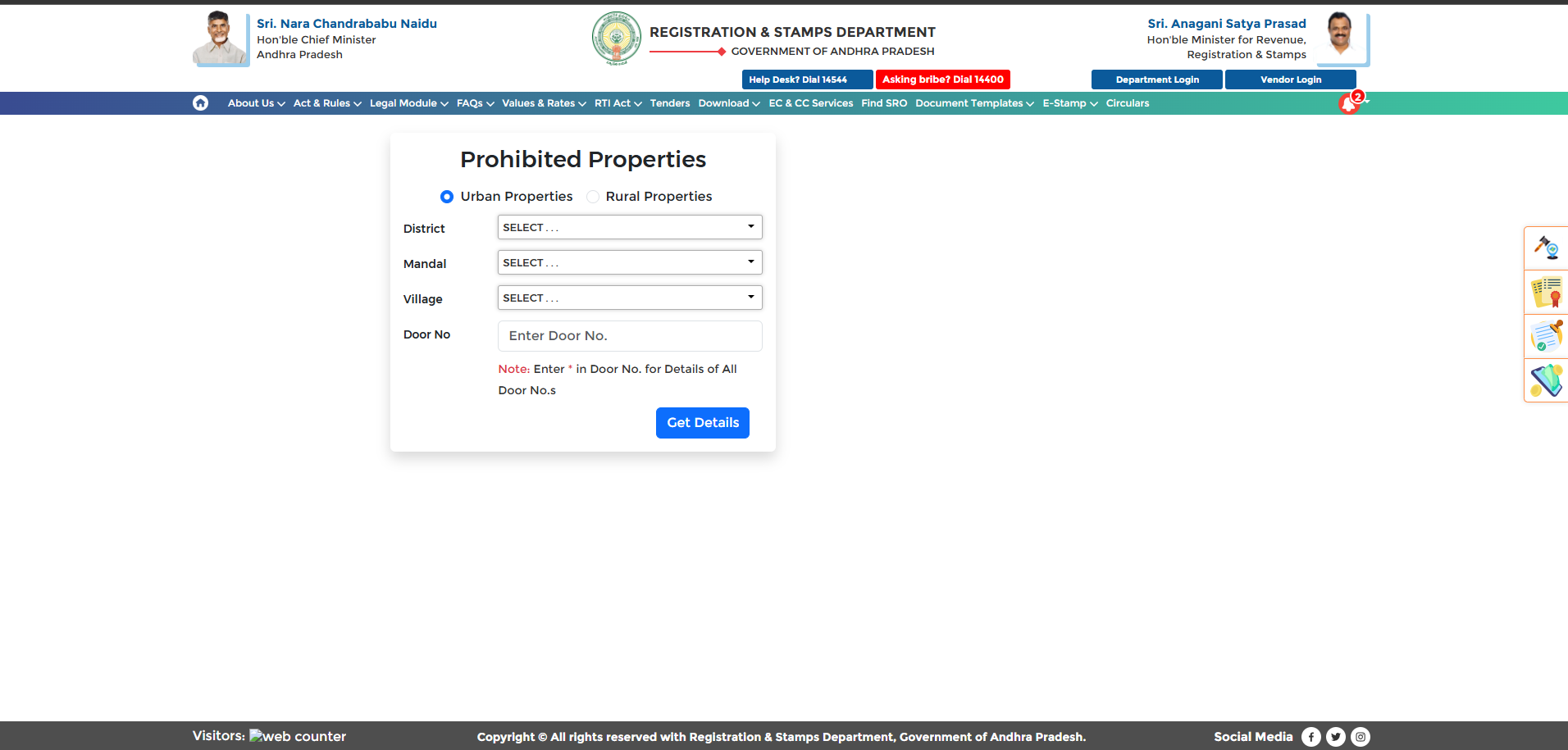
The Integrated Grievance Redressal System (IGRS) portal allows citizens to verify whether a property is listed under Section 22A.
- Visit the official IGRS Andhra Pradesh website.
- Open the “Prohibited Properties Search” section.
- Select the District, Mandal, and Village.
- Enter the Survey Number or Door Number.
- The system will display whether the property is prohibited, along with the reason and the authority responsible for the notification.
Cross-Verification Using Meebhoomi AP
While IGRS provides registration-related information, Meebhoomi helps verify ownership and revenue records.
Adangal
The Adangal record contains details such as land usage, cultivation information, soil classification, and possession status.
1-B (Record of Rights)
This document provides ownership history and land classification details.
Comparing records from both portals helps ensure that private lands have not been incorrectly categorized as government property or restricted land.
2026: Andhra Pradesh’s “Year of Land Reforms”
The Andhra Pradesh Government has designated 2026 as “Bhumi Nama Samvatsaram” with a strong focus on correcting historical land record errors and resolving long-pending property disputes.
Five Categories Removed from the Prohibited List
Effective January 1, 2026, the government approved the removal of the following categories from the Section 22A prohibited list:
- Lands assigned to serving and retired defence personnel.
- Lands granted to freedom fighters.
- Lands allotted to political sufferers and other eligible beneficiaries.
- Genuine assignments made before June 18, 1954.
- Private patta lands that were wrongly categorized as government property due to data-entry or Webland errors.
Mandatory Subdivision of Disputed Survey Numbers
Earlier, if a small portion of a survey number was under dispute, the entire survey number could be blocked from registration. Under the revised 2026 guidelines, authorities must now subdivide such survey numbers.
As a result, only the disputed portion remains restricted, while the undisputed area becomes eligible for registration without unnecessary delays.
Procedure for Removal from the 22A Prohibited List
The government has simplified the deletion process to reduce delays and inconvenience for landowners.
Step 1: Collect Supporting Documents
Applicants can establish their claim using any one of the following records:
- 10(1) Registers
- Adangal/Pahani Records
- Settlement Fair Adangals (SFA)
- Assignment Registers
- DKT (D-Form) Pattas
- Record of Holdings
- Registered Sale or Title Documents
- 8-A Registers
Step 2: Submit the Application
Applications can be submitted through MeeSeva centers or special Revenue Conferences conducted at the village level.
Expected Timelines
- Clerical or data-entry errors on private lands are generally resolved within 15–45 days.
- Assignment-related cases may take between one and three months depending on verification requirements.
Authority Responsible for Approval
For properties falling under clauses (a), (b), (d), and (e), the District Collector serves as the final authority for approving deletion from the prohibited list.
Impact of Inclusion in the 22A List
Being listed under Section 22A can significantly affect a property’s usability and marketability.
Registration Restrictions
Property owners cannot legally sell, gift, transfer, or mortgage land that appears on the prohibited list.
Loan Rejections
Banks and financial institutions routinely verify 22A status and may reject loan applications involving restricted properties.
Reduced Market Value
Since buyers generally avoid properties with legal restrictions, affected lands often experience a substantial decline in demand and market value.
Role of the AP Lokayukta in Land-Related Grievances
The Andhra Pradesh Lokayukta plays an important role in addressing complaints related to land administration and revenue department irregularities.
Grievance Resolution
Thousands of complaints relating to revenue administration and land records have been reviewed through Lokayukta intervention.
Rectification of Illegal Entries
The institution has helped authorities identify and correct numerous irregular or unauthorized land record entries.
Protection of Public Interest
Its interventions have also contributed to preventing misuse of public resources and improving accountability within the land administration system.
Frequently Asked Questions (FAQs)
Can I purchase a property listed under Section 22A?
No. The registration system automatically blocks transactions involving properties included in the prohibited list.
How long does the removal process take?
Private patta land corrections are generally completed within 15–45 days, while assignment-related cases may require one to three months.
Is there any fee for checking property status?
No. Property verification through the IGRS portal is available free of charge.
What happens if a prohibited property is registered by mistake?
Such registrations may be challenged and can ultimately be declared invalid through legal proceedings.
Do lands assigned to ex-servicemen have a lock-in period?
Yes. In many cases, assigned lands granted to ex-servicemen or freedom fighters can only be transferred after completion of the prescribed lock-in period, typically ten years from the date of assignment.
With the ongoing land reforms and digitization initiatives, Andhra Pradesh aims to create a more transparent, secure, and reliable land administration system. Property owners should utilize this opportunity to verify records, correct errors, and ensure clear ownership before undertaking any property transaction.